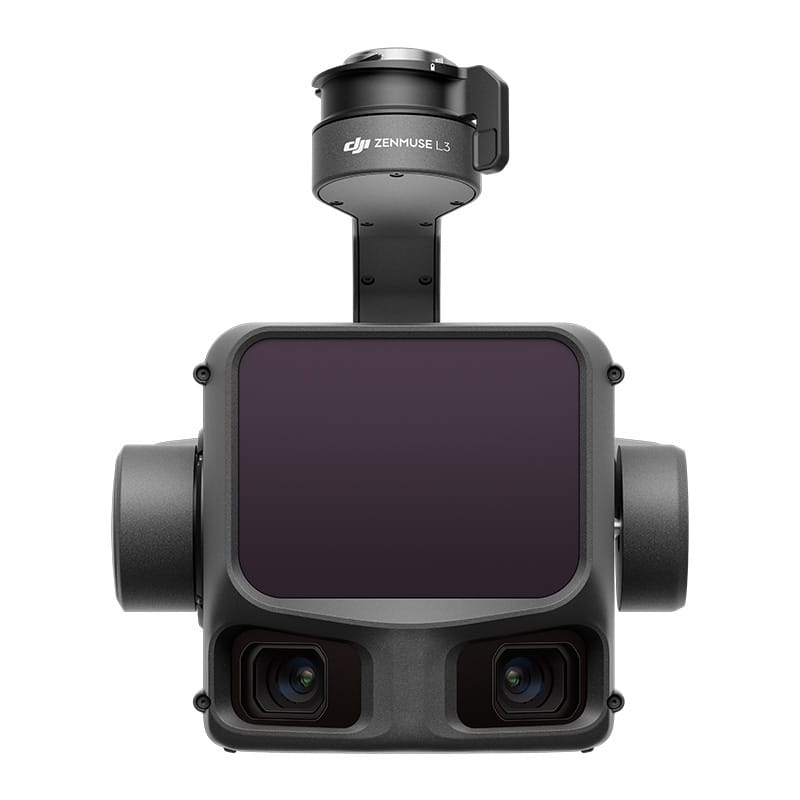
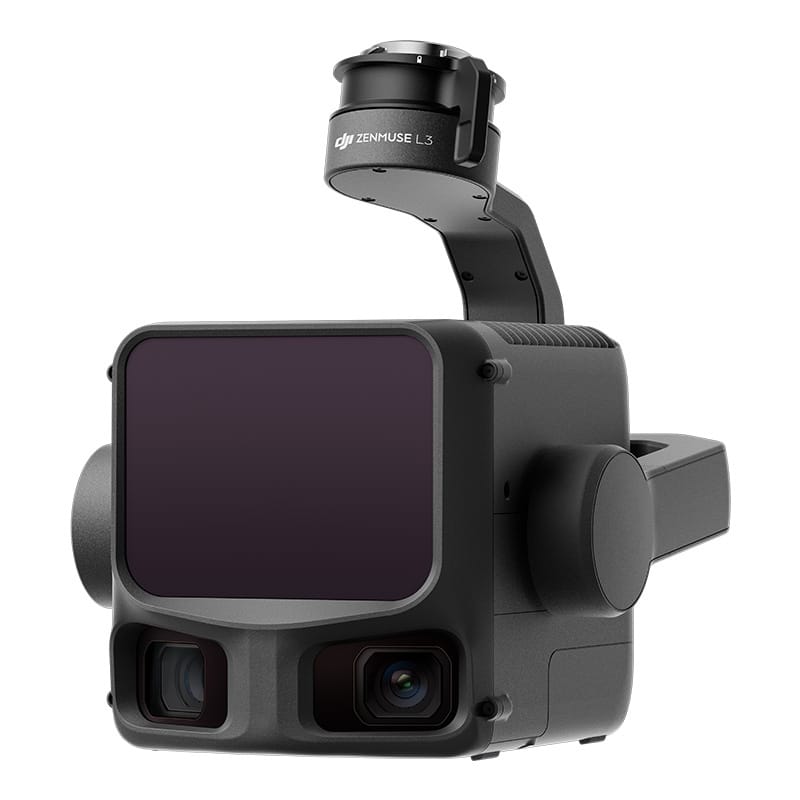
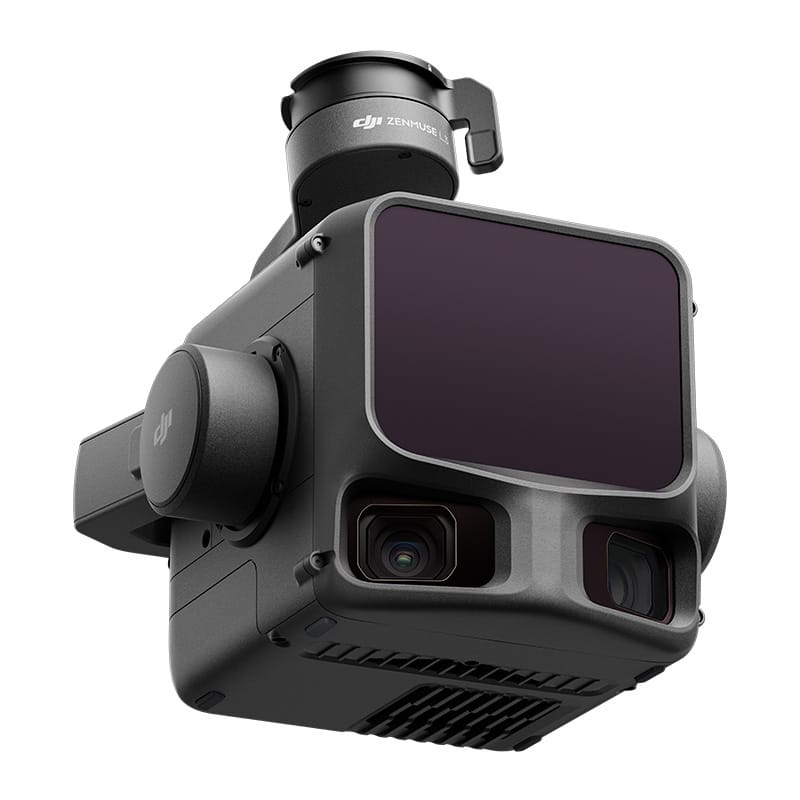
Long range and wide coverage
At the heart of the Zenmuse L3 is a 1535 nm wavelength LiDAR rangefinder, offering a detection range of up to 950 m with 10% reflectivity. The adjustable pulse frequency (up to 100 kHz) allows you to precisely adjust the power to a specific mission scenario, ensuring an optimal balance between range, point cloud density, and operational efficiency. At typical flight altitudes of 300-500 m, the system significantly increases the area covered by a single flight, reducing the time needed to acquire terrain data.
Beam precision and high penetration
Zenmuse L3 uses a beam with extremely low divergence—just 0.25 mrad (1/e²). This means that the laser spot at the same distance is up to five times smaller than in the previous model. In practice, this allows for the detection of small objects such as power lines or tree branches while maintaining a high point density on the ground. Higher pulse energy density translates into more effective vegetation penetration and better terrain structure mapping. What’s more, Zenmuse L3 generates up to 2 million laser pulses per second, supporting up to 16 returns. This allows for exceptionally detailed point clouds and precise spatial reconstruction, both in open terrain and complex environments. You can also adjust the point density and penetration capability depending on the requirements of the task.
Scanning modes tailored to your mission
Zenmuse L3 offers three scanning modes, so you can tailor its performance to the requirements of your current mission. Linear mode provides even point distribution, making it ideal for topographic mapping. Star-Shaped mode combines multiple scanning angles and greater penetration, making it suitable for forest or urban environments. Non-Repetitive mode offers wider coverage and a variety of viewing angles, making it particularly useful for inspecting transmission lines or technical structures.
Dual 100 MP RGB camera system
Two RGB cameras with 4/3 CMOS sensors with a resolution of 100 MP and a mechanical shutter ensure excellent image quality and accuracy. Binning technology generates an effective resolution of 25 MP with larger pixels, which guarantees better colors and rich details even in low light conditions. An additional advantage is the wide 107° field of view, which allows you to cover a much larger area. Even with a 20% overlap rate, you can collect data for both digital orthophotomaps (DOM) and digital elevation models (DEM) in a single flight. This solution reduces mission time and improves operational efficiency!
Precise POS system and data accuracy
The built-in proprietary POS system achieves an accuracy of 0.02° in direction and 0.01° in tilt (after processing, 1σ). LiDAR, on the other hand, has a distance measurement repeatability of 5 mm at 150 m, with microsecond time synchronization. Each Zenmuse L3 unit undergoes rigorous factory calibration to ensure repeatable and reliable measurement results in professional applications. The vertical accuracy of LiDAR data is up to 3 cm at an altitude of 120 m, 5 cm at 300 m, and 10 cm at 500 m – these parameters allow for projects on a scale of 1:500, 1:1000, and 1:2000. In addition, thanks to two 100 MP RGB cameras, the system achieves a GSD of 3 cm at a flight altitude of 300 m. Precise real-time position synchronization allows for the capture of high-quality images without the need for ground control points (GCPs), reducing the time required to complete the task.
High work efficiency and impressive penetration capability
With a smaller laser spot and higher single pulse energy, Zenmuse L3 offers excellent penetration capability. For example, when mapping terrain, the device captures more ground points, improving data accuracy and integrity. What’s more, when paired with the DJI Matrice 400 drone, the camera can cover up to 10 km² in a single flight and up to 100 km² per day. In addition, simultaneous LiDAR and RGB data capture means that a single flight is enough to create a point cloud, 3D model, DEM, or DOM.
Complete DJI Enterprise Ecosystem
Zenmuse L3 is part of the fully integrated DJI Enterprise ecosystem, which provides a complete process from mission planning to analysis and reporting of results. DJI Pilot 2 offers automatic parameter recommendations, density profile visualization, and point cloud distribution even before takeoff, while real-time preview mode (2D/3D) and SLAM reconstruction are available during flight, allowing for immediate verification of progress and accuracy. You can also check two sources of information on a split screen and use the Power Line Follow feature, which is useful when inspecting power lines. Data can be automatically uploaded to the cloud via DJI FlightHub 2, where it can be analyzed, annotated, and measured directly in the browser interface.
Advanced data processing and analysis
Zenmuse L3 works with the DJI Terra platform, which supports PPK processing for LiDAR and RGB data, providing centimeter-level positioning accuracy without RTK. The use of Gaussian Splatting technology allows for greater realism and richness of detail, while data integration streamlines the generation of point clouds, 2D maps, and 3D models. In addition, DJI Modify software facilitates data classification and analysis.
Security and reliability
Zenmuse L3 supports CFexpress memory card encryption, protecting data from unauthorized access. When paired with the DJI Matrice 400 drone, the system uses AES-256 video transmission encryption and one-click log clearing, meeting the highest standards of information security in industrial and public applications.